


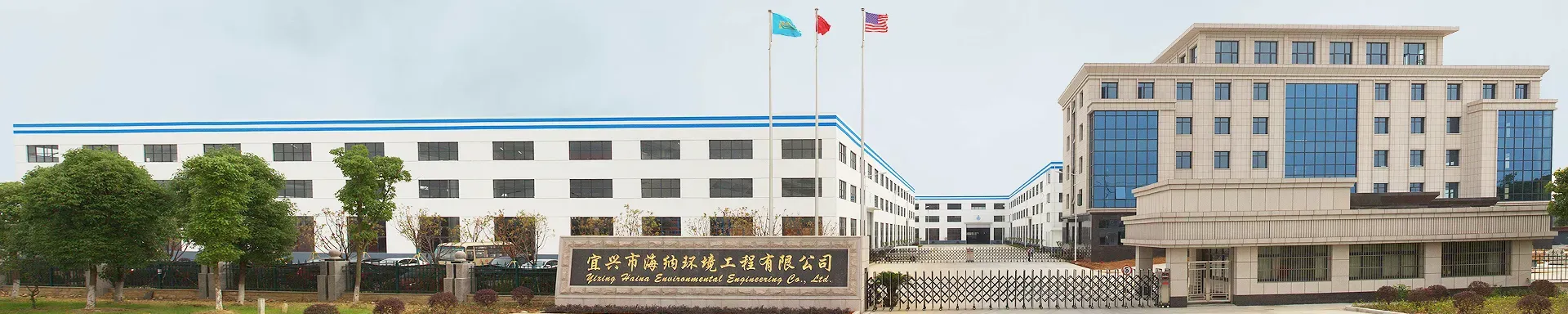
Why Dust Collectors Fail at Scale?
2026-10-01 16:05When a foundry in Ohio upgraded its melting line, the operations manager expected a smooth increase in production. Instead, the baghouse that had served faithfully for years began choking on the additional volume. Differential pressure spiked, filters blinded within weeks, and the entire facility faced unplanned shutdowns. This scenario is all too common: as air volumes grow from medium to large, conventional dust collectors hit a wall. The question isn't whether your dust collector can handle medium and large air volumes—it's whether it can do so efficiently, reliably, and without costing you a fortune in energy and maintenance. In this blog, we'll dissect the three critical pain points that plague high-volume dust collection and show you how Yixing Haina Environmental Engineering Co., Ltd. delivers engineered solutions that keep large-scale operations running clean.
Pain Point 1: Inadequate Air-to-Cloth Ratio Leading to Filter Overload
Air-to-cloth ratio (ACR) is the lifeblood of any dust collection system. It defines how many cubic feet per minute (CFM) of air passes through each square foot of filter media. For medium air volumes (say, 5,000–20,000 CFM), a slightly aggressive ACR might be forgiven. But when you scale to large volumes—30,000, 50,000, even 100,000 CFM—an inappropriate ACR becomes catastrophic. Many facilities simply buy a bigger version of their old collector, assuming the same ACR will work. It doesn't. High ACR means higher filtration velocity, which drives dust particles deeper into the filter fabric, causing rapid plugging. The result: frequent filter replacements, increased pressure drop, and reduced airflow that starves your process.
Consider a typical woodworking plant in North Carolina that expanded its production line. They installed a dust collector rated for 40,000 CFM but with an ACR of 8:1—far too high for the fine sawdust they generated. Within three months, filters were failing every six weeks. Each replacement cost $12,000 in parts and $8,000 in labor, plus lost production during changeouts. The total annual cost exceeded $150,000—money that could have been saved with a properly sized system.
Pain Point 2: Energy Inefficiency and Excessive Pressure Drop
Large air volume systems consume enormous amounts of energy. Fans must move massive volumes of air through ductwork, filters, and hoods. If the system is not optimized, pressure drop across the filters can climb from a design 4 inches water gauge to 10 inches or more. This directly increases fan power consumption, often by 30–50%. For a 50,000 CFM system, that could mean an additional 75 kW of electricity—roughly $50,000 per year in energy costs at industrial rates. Moreover, many facilities use fixed-speed fans that cannot adjust to changing demand, wasting energy during off-peak production.
A metal fabrication shop in Michigan experienced this firsthand. Their 60,000 CFM dust collector used a fixed-speed fan and had a pressure drop of 9 inches water gauge. Energy bills were astronomical, and the local utility threatened penalties for excessive demand. They were also facing compliance issues because the collector couldn't maintain the required capture velocity at welding stations.
Pain Point 3: Maintenance Nightmares and Unplanned Downtime
Medium and large dust collectors are not set-and-forget equipment. They require regular filter changes, hopper cleaning, valve maintenance, and fan inspections. But when systems are poorly designed, maintenance becomes a nightmare. For example, if the collector lacks proper access platforms or filter removal mechanisms, technicians spend hours in awkward positions, increasing labor costs and safety risks. More critically, unexpected filter failures can shut down an entire production line. In industries like cement or pharmaceuticals, even a few hours of downtime can cost tens of thousands of dollars.
A cement plant in Texas ran a 100,000 CFM baghouse that suffered from chronic filter failures due to inadequate pre-cleaning. The filters would fail without warning, releasing dust into the atmosphere and triggering environmental fines. Each unplanned outage cost $25,000 in lost production, and the plant faced $10,000 per day in penalties for non-compliance. The maintenance team was constantly firefighting, unable to focus on preventive measures.
Solution 1: Engineered Air-to-Cloth Ratio and Custom Filter Media
The first step to solving high-volume dust collection is proper engineering. At Yixing Haina Environmental Engineering Co., Ltd., we start by analyzing your dust characteristics—particle size distribution, abrasiveness, moisture content, and explosivity. Based on this, we calculate the optimal air-to-cloth ratio. For medium and large air volumes, we typically recommend ACRs between 2:1 and 5:1, depending on the application. For fine dusts like fumed silica, we might go as low as 1.5:1. This ensures that the filter media can handle the dust load without excessive velocity.
We also select the right filter media. For high-volume applications, we often use pleated cartridges or high-efficiency bags made from PTFE, polyester, or aramid fibers. These media offer high filtration efficiency, low pressure drop, and long service life. In the woodworking case, we redesigned the system with an ACR of 3:1 and used pleated cartridges with a nanofiber coating. Filter life extended from 6 weeks to 18 months, saving the plant over $120,000 annually.
Solution 2: Optimized System Design for Energy Savings
Energy efficiency in large dust collectors is achievable through smart design. We incorporate variable frequency drives (VFDs) on fan motors to match airflow to actual demand. By monitoring pressure drop and production schedules, the VFD adjusts fan speed, reducing energy consumption by up to 40%. We also design ductwork to minimize pressure losses, using gradual transitions and smooth bends. Hoods are engineered to capture dust with minimal airflow, further reducing the total volume required.
For the Michigan metal fabrication shop, we installed a 60,000 CFM collector with a VFD-controlled fan and optimized ducting. Pressure drop dropped from 9 to 4.5 inches water gauge, cutting fan power from 150 kW to 90 kW. Annual energy savings exceeded $45,000. The system also maintained consistent capture velocity, satisfying OSHA and EPA requirements.
Solution 3: Smart Maintenance and Predictive Analytics
To eliminate maintenance nightmares, we integrate IoT sensors and predictive analytics into our dust collectors. Differential pressure sensors, flow monitors, and vibration sensors continuously feed data to a cloud-based platform. Algorithms detect early signs of filter blinding, valve wear, or fan imbalance. Maintenance alerts are sent to technicians via mobile app, allowing them to schedule repairs during planned downtime. This shifts maintenance from reactive to proactive, reducing unplanned downtime by up to 70%.
For the Texas cement plant, we retrofitted their baghouse with our smart monitoring system. Within weeks, the system predicted a filter failure due to a faulty solenoid valve. The plant replaced the valve during a scheduled maintenance window, avoiding a $25,000 outage. Over two years, the plant reduced unplanned downtime by 80% and eliminated environmental fines. The maintenance team now focuses on optimization rather than firefighting.
Customer Success Stories
Case 1: Woodworking Plant in North Carolina
After redesigning the dust collection system with Yixing Haina, the plant saw filter life increase from 6 weeks to 18 months. Annual savings: $120,000. "We finally have a system that keeps up with our production without constant filter changes," said Plant Manager John D.
Case 2: Metal Fabrication Shop in Michigan
Energy consumption dropped by 40%, saving $45,000 per year. "The VFD and optimized ducting paid for themselves in 14 months," remarked Operations Director Lisa M.
Case 3: Cement Plant in Texas
Unplanned downtime reduced by 80%, saving $200,000 annually in lost production and fines. "The predictive maintenance system is a game-changer," said Maintenance Supervisor Carlos R.
Case 4: Pharmaceutical Facility in New Jersey
Yixing Haina provided a 30,000 CFM dust collector with HEPA filters to meet strict FDA requirements. The system achieved 99.99% efficiency and passed audits with zero findings. "Their understanding of cleanroom standards is exceptional," noted Quality Manager Susan K.
Case 5: Food Processing Plant in California
A 45,000 CFM collector was installed to handle sticky, moist dust from spice grinding. Yixing Haina used a special stainless steel construction and a heated hopper to prevent condensation. Filter life improved from 3 months to 2 years. "They solved a problem that others couldn't," said Plant Engineer David L.
Applications and Partnerships
Our dust collectors for medium and large air volumes are deployed across a wide range of industries: woodworking, metalworking, cement, pharmaceuticals, food processing, chemicals, and power generation. We partner with leading OEMs and engineering firms to integrate our systems into complete process lines. For instance, we supply dust collectors to a major automotive manufacturer for its paint booths and welding lines. We also collaborate with environmental consultants to ensure compliance with EPA, OSHA, and EU directives. Our partnerships are built on trust, technical excellence, and a shared commitment to clean air.
FAQ for Engineers and Procurement Managers
Q1: What is the maximum air volume your dust collectors can handle?
A: We design custom systems up to 200,000 CFM and beyond. Our modular approach allows us to scale to any size.
Q2: How do you determine the right air-to-cloth ratio for my application?
A: We conduct a dust analysis and consider factors like particle size, loading, and moisture. We then use our proprietary software to calculate the optimal ACR.
Q3: Can your systems handle explosive dust?
A: Yes. We offer explosion-vented, suppression, and isolation systems that meet NFPA standards.
Q4: What is the typical lead time for a large dust collector?
A: Depending on customization, lead times range from 8 to 16 weeks.
Q5: Do you provide after-sales support and spare parts?
A: Absolutely. We offer 24/7 technical support, remote diagnostics, and a global spare parts network.
Conclusion and Call to Action
Scaling dust collection from medium to large air volumes doesn't have to be a headache. With proper engineering, energy-efficient design, and smart maintenance, you can achieve reliable, compliant, and cost-effective operation. Yixing Haina Environmental Engineering Co., Ltd. has the expertise and technology to make it happen. Contact us today to request our technical white paper on high-volume dust collection or to speak with a sales engineer. Don't let dust hold your production back.