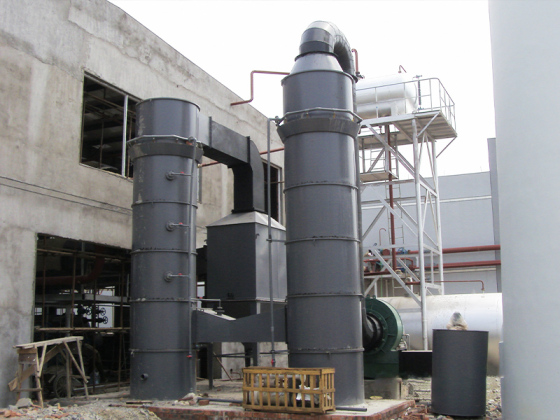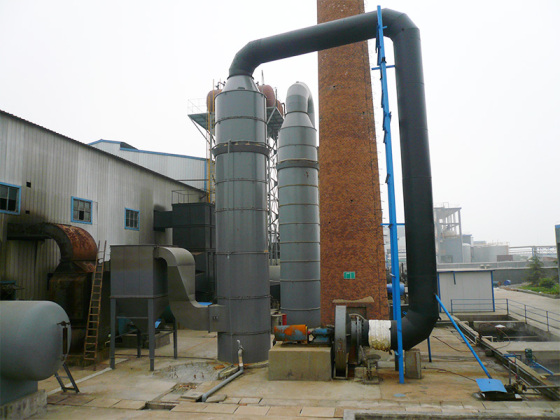


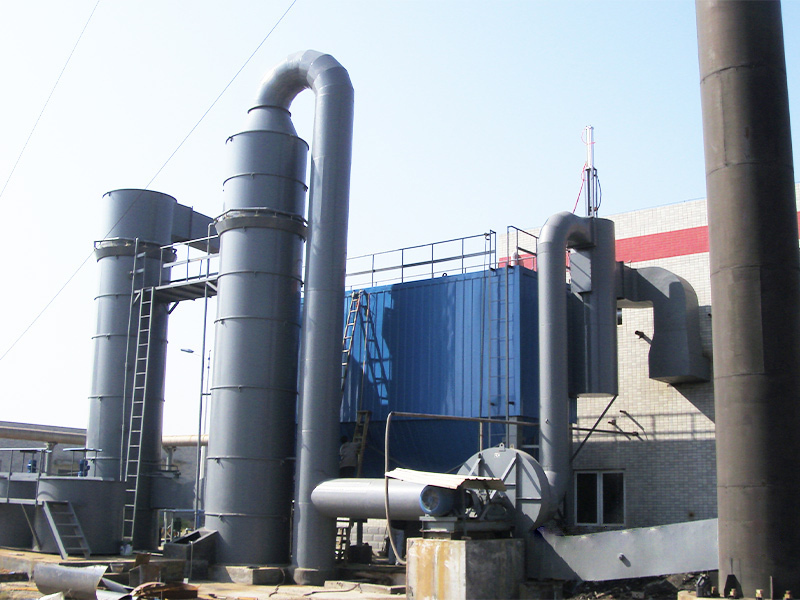
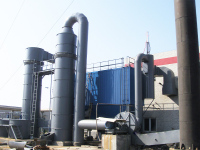
Twin tower water film desulfurization tower
The HXL type water film desulfurization dust collector (quick load module type) is optimized and improved on the basis of the traditional hemp water film tower. The steel plate and granite are perfectly combined into each functional module by high strength anti-permeability and acid-proof castable, and are hoisted and combined on site. It is suitable for all kinds of boilers and kilns because of its advantages such as convenient installation, short construction time, low maintenance cost and long service life.
- Information
Product Overview
HXL Type Water Film Desulfurization Dust Collector Introduction
The HXL type water film desulfurization dust collector (quick load module type) is optimized and improved on the basis of the traditional hemp water film tower. The steel plate and granite are perfectly combined into each functional module by high strength anti-permeability and acid-proof castable, and are hoisted and combined on site. It is suitable for all kinds of boilers and kilns because of its advantages such as convenient installation, short construction time, low maintenance cost and long service life.
| Device components | ||||||
| Flue gas outlet | Coil pipe | Water tank | Tower body | Venturi (Flue gas inlet) | Overflow hole | Cleanup hole |
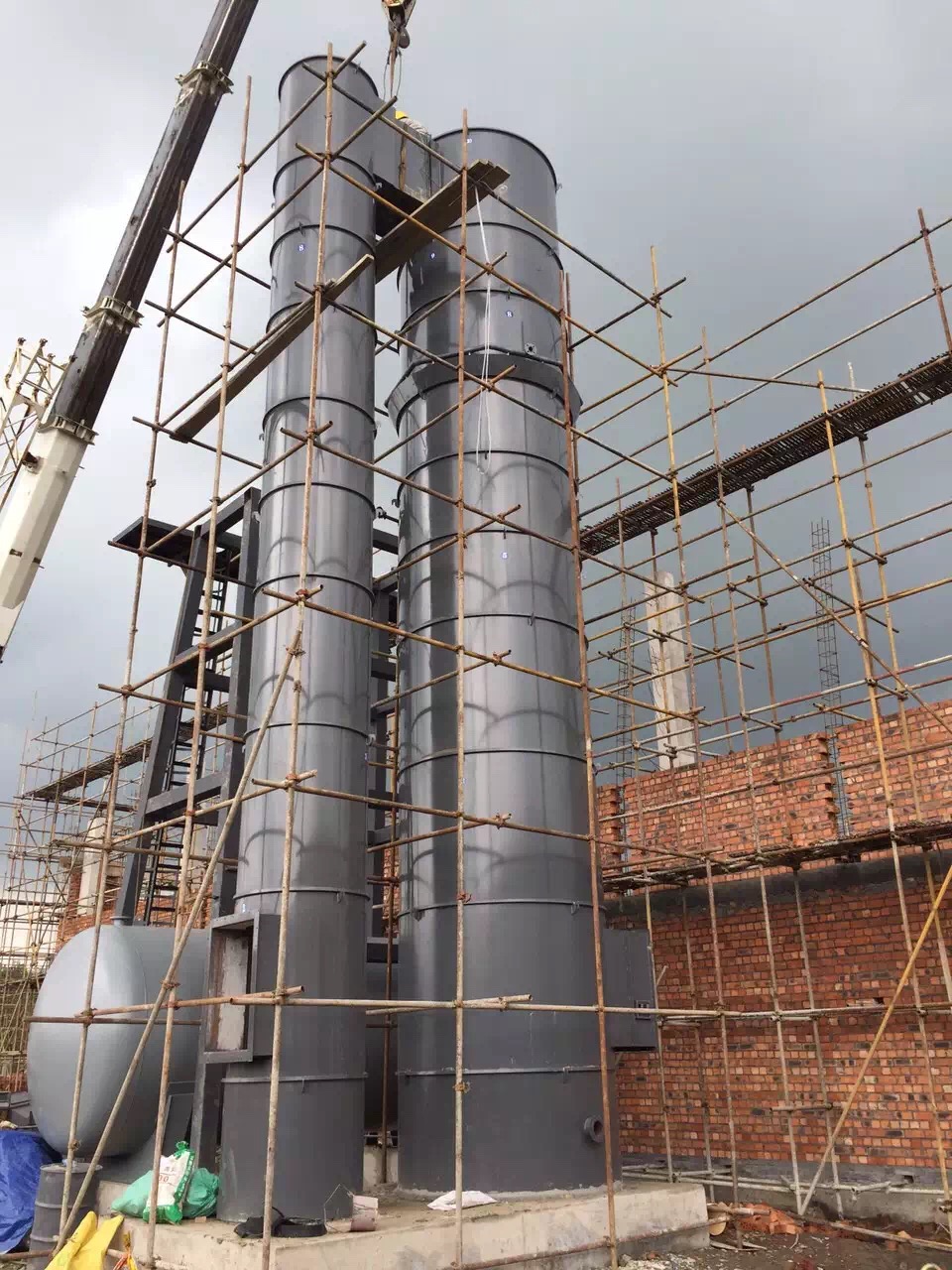
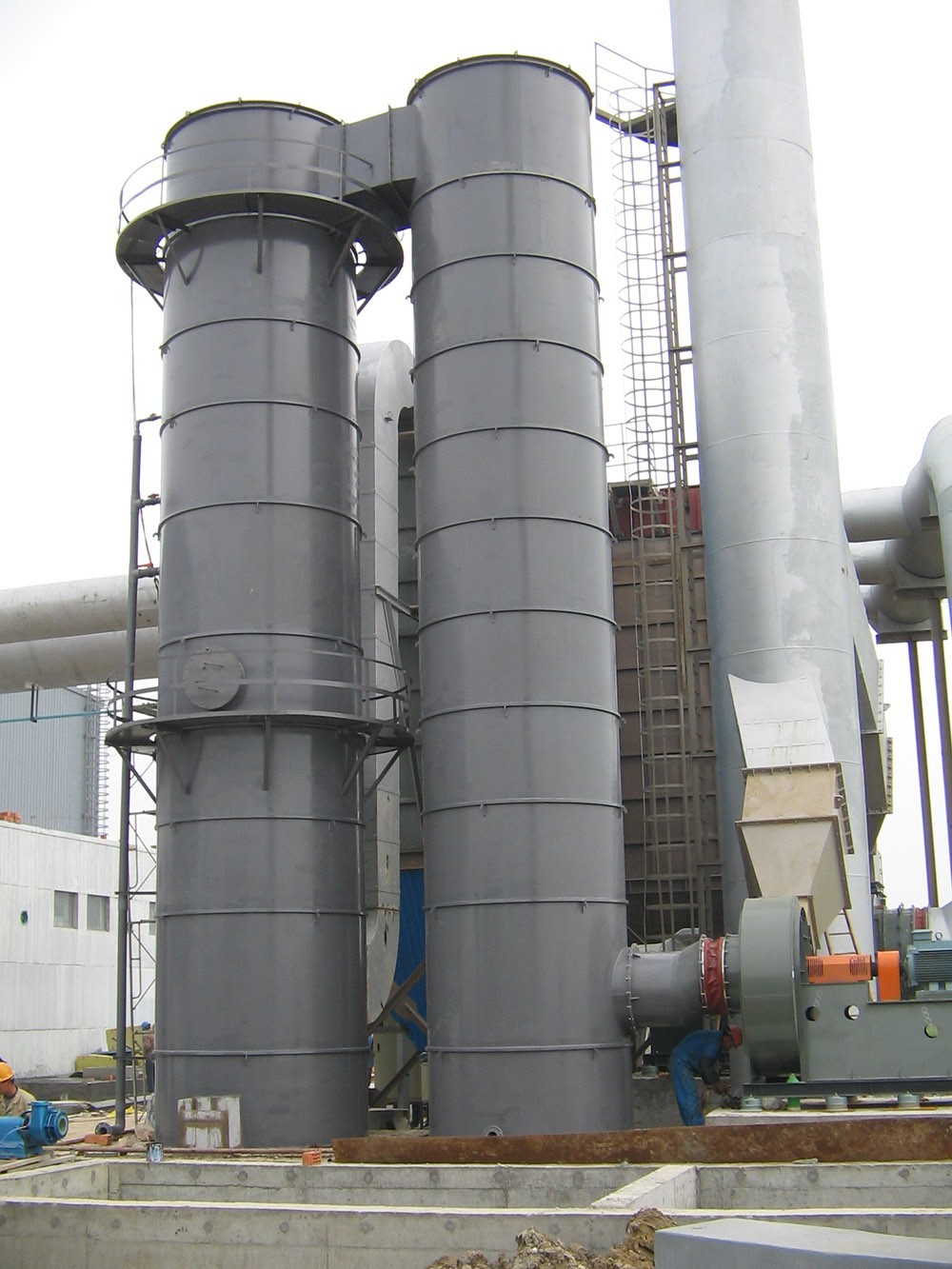
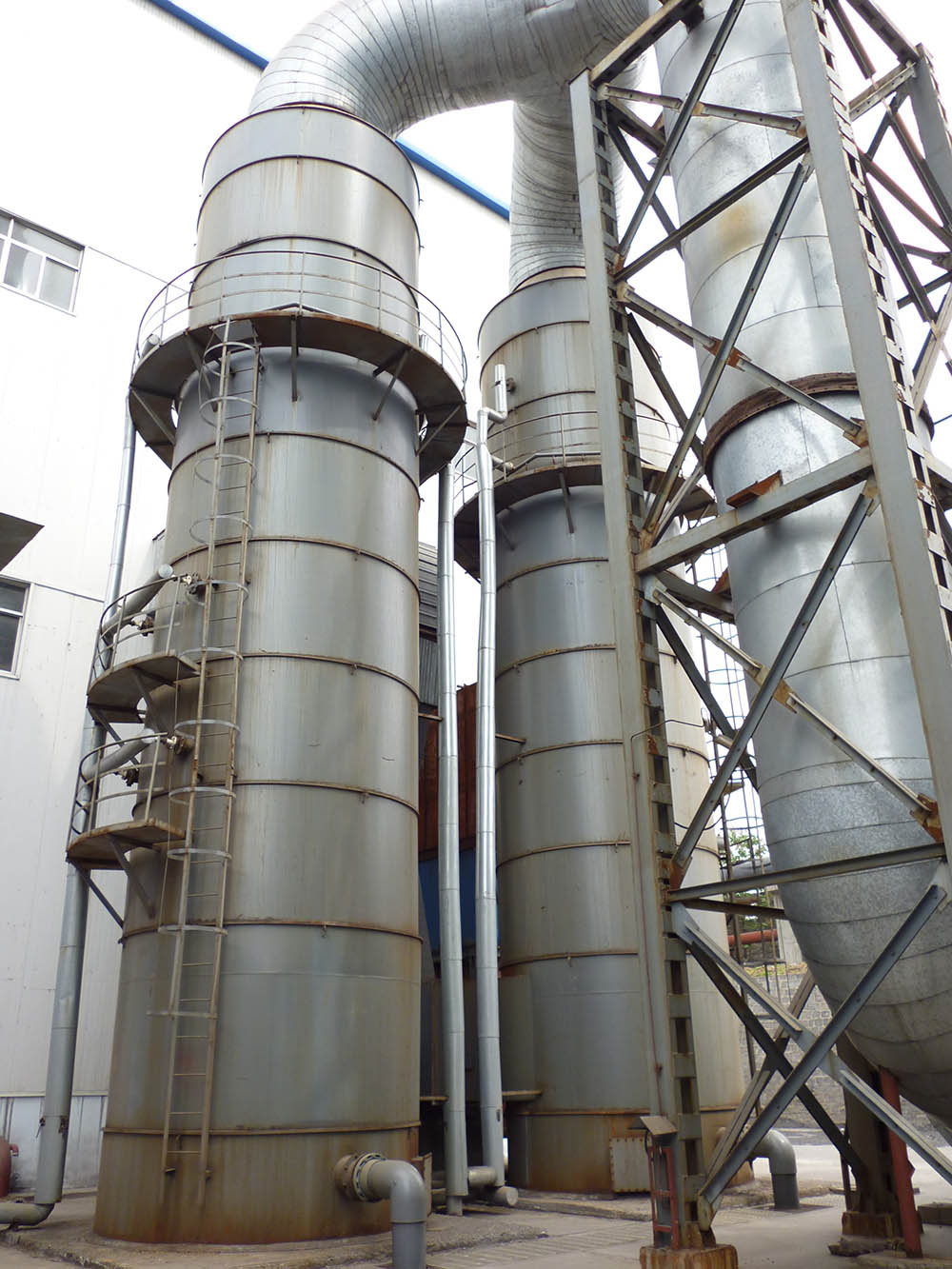
Working Principle
The dusty gas is introduced tangentially from the lower part of the cylinder and rotates upward. The dust particles are separated by centrifugal force and thrown to the inner wall of the cylinder. Adsorbed by the water film layer flowing on the inner wall of the cylinder, it flows to the bottom of the tower along with the film and is discharged through the overflow port. The water film layer is hung down along the cylinder wall after the water tank on the upper part of the cylinder is full and overflows, and is fully mixed with the rotating flue gas for washing, so as to achieve the purpose of dust removal effect.
Characteristics
1. The cylinder is lined with natural granite with acid resistant castable in the middle. The internal structure is smooth and level to ensure the integrity of the inner water film;
2. The internal anticorrosion adopts heavy anticorrosion, with unique advantages in the aspects of erosion resistance, corrosion resistance and high temperature resistance. The service life of the equipment is more than 10 years;
3. The upper water tank is ceramic structure to ensure no water leakage during the use process;
4. The height of each module is no more than 2m, light weight and convenient installation;
5. Concave and convex joints are adopted between modules, and high strength corrosion-resistant materials are used as sealing treatment to ensure no air leakage and water leakage.
Equipment installation
a. Installation of equipment base: first of all, 1-2cm thick cement mortar is spread on the basis of the equipment. When installing, the base is in horizontal position, and the water outlet of the base is aligned to the direction of the circulating pool. After the base is in place, the upper flange ring of the base is covered with 1-2cm thick jointing cement.
b. Equipment import installation: determine the import position (ensure that the equipment import center and boiler air duct center basically consistent, easy to connect the air duct. Hoist the inlet section to the base and slowly put it down. Pay attention to the concentricity of the two sets of equipment in the process of putting down. The installers need to correct at any time to ensure that the installation is in place.
c. Install the flume in turn according to the above steps.
d. After installing the flume section, use the ladder or scaffold to enter the equipment interior to clean the joint plaster which is pressed out from the tube joint and the joint, and fill the joint place with the jointed plaster to smooth it out.
e. Installation of circular pipes:
Pay attention to the position of Sheung Shui, insert the hose into the ceramic sink, use the connecting cement seal at the water pipe and sink socket (for example, if the equipment is equipped with Venturi device, the water flange of the ring water pipe should be close to the Venturi side, Facilitate the connection between Venturi and the annular pipe.
Project Progress
Sign the contract, formulate a production schedule, and carry out production in an orderly manner.
Formulate a progress schedule before the installation starts, strictly adhere to the total construction period, and complete the project ahead of schedule.
There is a professional installation team that has a good understanding of the products and rich installation experience.
Why Choose Us
| Basic Information | Established | 1995 |
| Registered Capital | RMB 68 million | |
| Annual Output Value | Over RMB 200 million | |
| Scale | Total Employees | 150 |
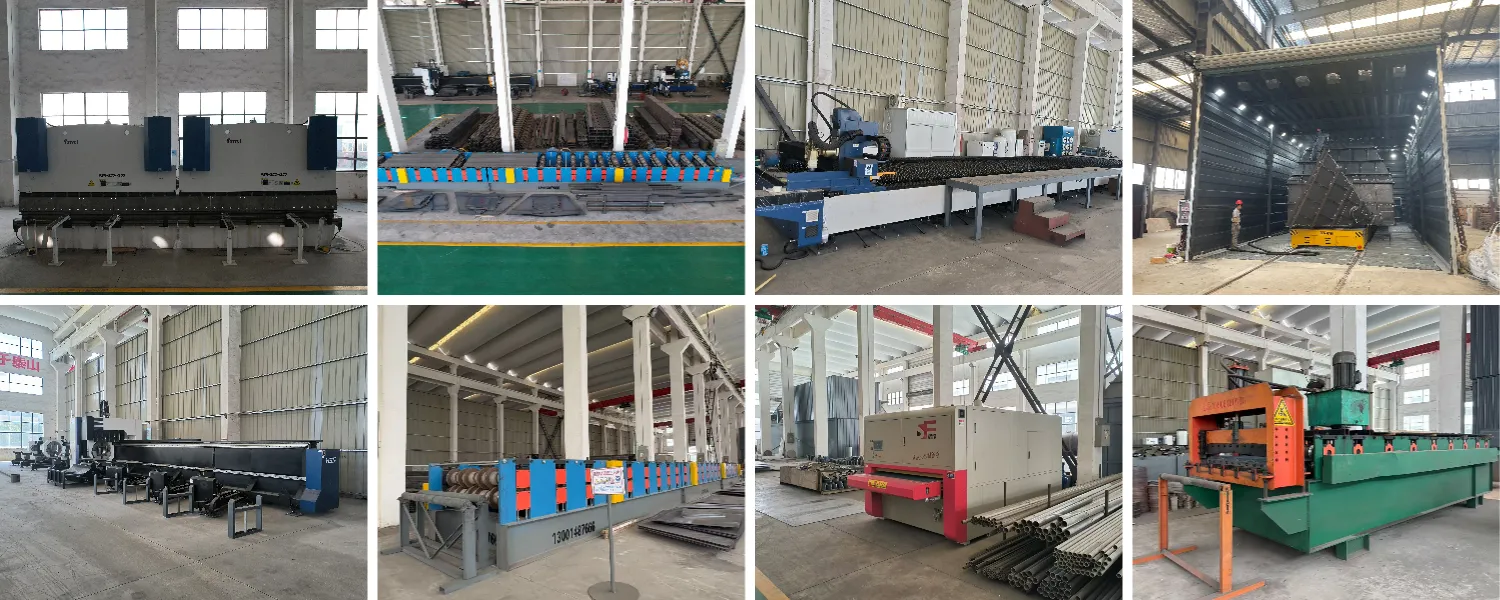
| Manufacturing Area | 35,000 ㎡ | |
| Project Experience | Total Engineering Projects | Nearly 500 |
| Denitrification Systems Delivered | ~3,000 units | |
| Dust Removal Systems Delivered | ~10,000 units | |
| Desulfurization Systems Delivered | ~5,000 units | |
| Wet Electrostatic Systems Delivered | ~250 units | |
| Technology | Patents | 50+ |
| Market Coverage | Export Regions | Africa, South America, Southeast Asia |
Manufacturing & Production Capacity
After-Sales Service
Haina provides on-site installation, commissioning and technical training.Regular follow-up inspections are arranged after project delivery to support long-term operation stability.
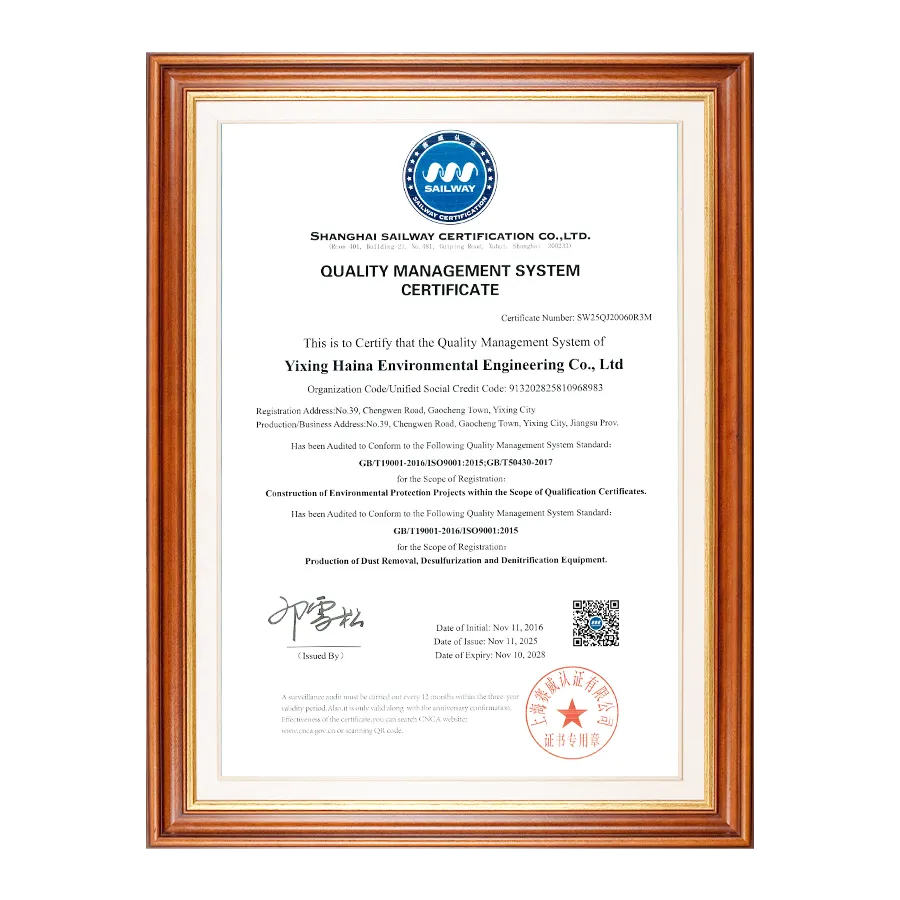
Quality Management SystemCertification Certificate |
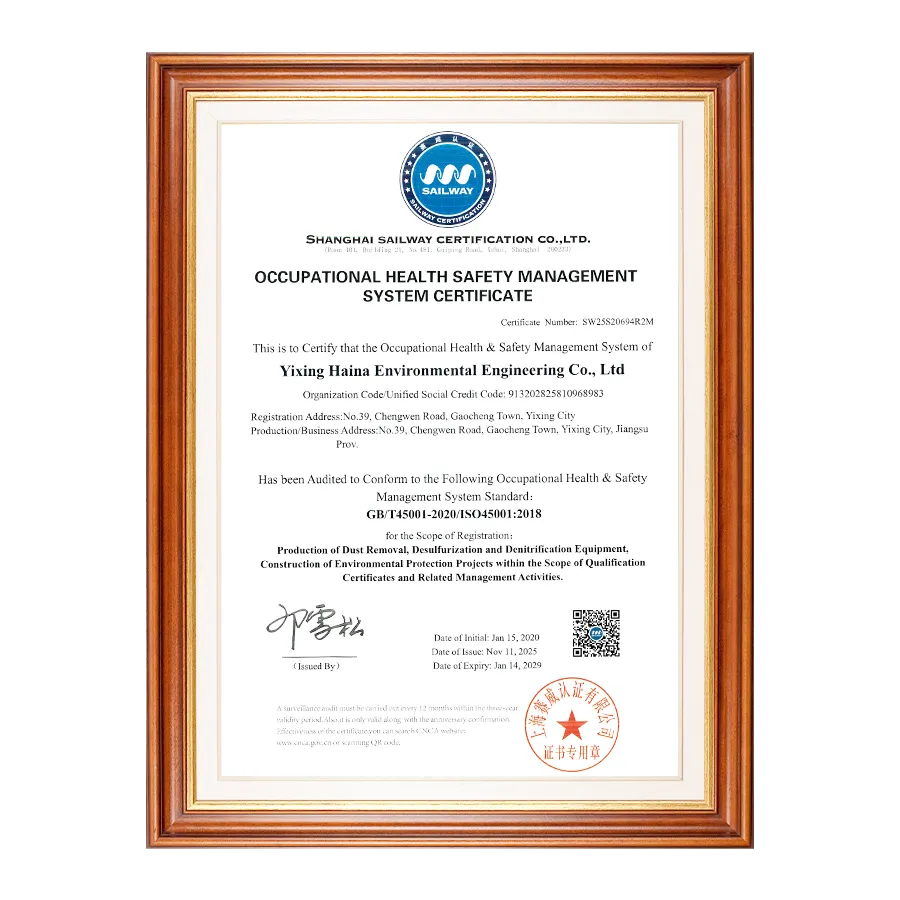
Occupational Health and Safety Management System Certification Certificate |
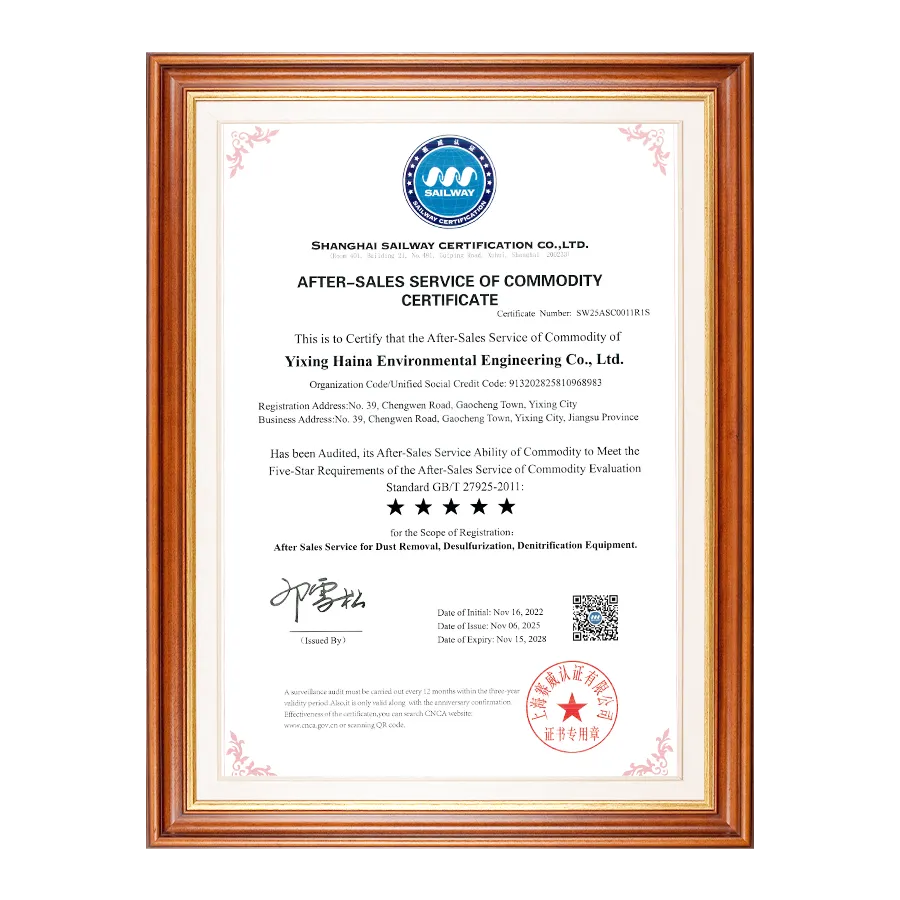
Certificate of After-Sales Service Certification for Products |
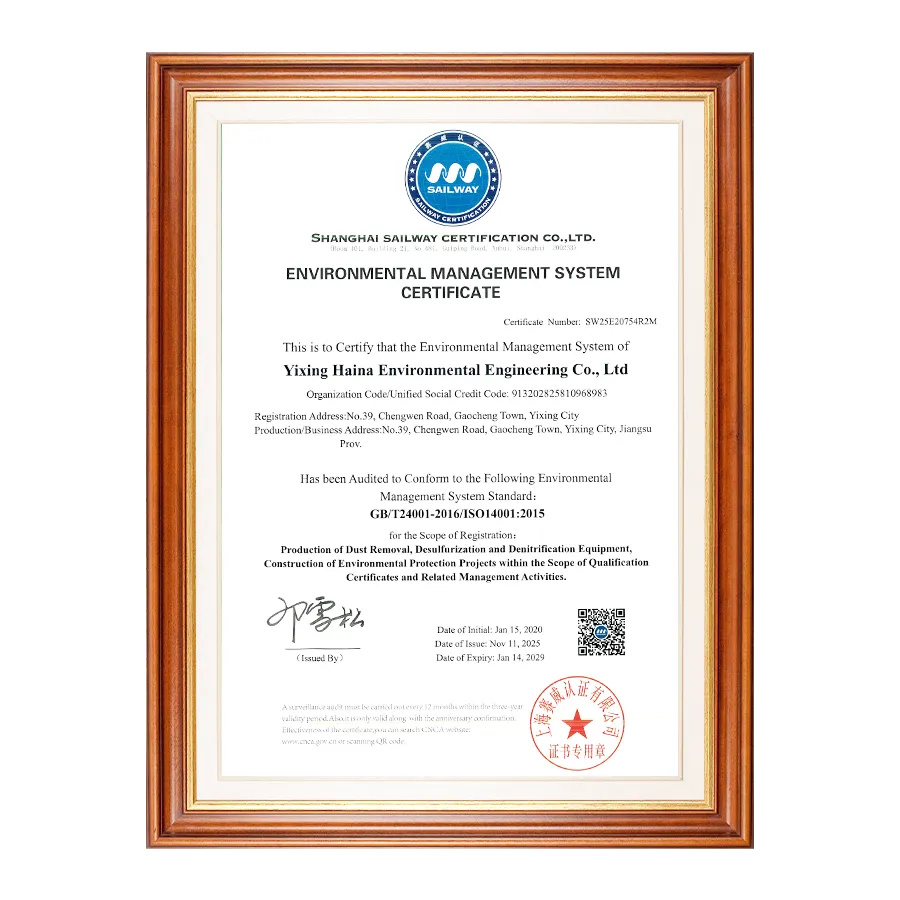
Environmental Management System Certification Certificate |
FAQ
1、What are the main structural differences between the double-tower water film desulfurization tower, the split modular water film tower, and the integral water film tower?
Split modular type: It is assembled on - site by hoisting multiple lightweight modules with a height of no more than 2 meters. It is flexible to install and suitable for occasions with transportation limitations.
Integral type: It is a pre - fabricated integrated structure in the factory, with a relatively large volume. High requirements are needed for transportation and hoisting, and it is suitable for supporting small boilers.
Double - tower type: It adopts a design of two independent towers in series operation, forming a "primary + secondary" double purification system, which significantly improves the efficiency of dust removal and desulfurization.
2、Why is it said that the double-tower design has more advantages in purification effect?
The double-tower design enables two-stage wet scrubbing:
The first tower completes the preliminary dust removal and desulfurization;
The second tower conducts in-depth purification, further capturing residual dust and SO₂ gas.
Compared with the single-tower structure (whether split or integrated), it has the following advantages:
Higher purification efficiency
More stable emissions, making it easier to meet stringent environmental protection standards
Stronger adaptability to flue gas load fluctuations and better impact resistance.
3、Is it more difficult to install and maintain the double-tower type?
Although the double-tower type occupies a slightly larger area, it has a high degree of modularity and can still be constructed by on-site assembly. Moreover, it has the following conveniences:
The components are designed in a standardized way, and the installation process is clear;
It can be overhauled in sections without shutting down the entire system;
It is equipped with complete maintenance structures such as cleaning holes and overflow ports, which makes daily operation and maintenance convenient.
4、Under which working conditions is the double-tower type more suitable?
Industrial scenarios with large flue gas volume and high dust/sulfur content.
Areas with strict local environmental protection requirements, where long-term stable and up-to-standard emissions are needed.
Upgrading of existing single-tower systems to improve treatment capacity.
Users' pursuit of higher system reliability and operational flexibility.